

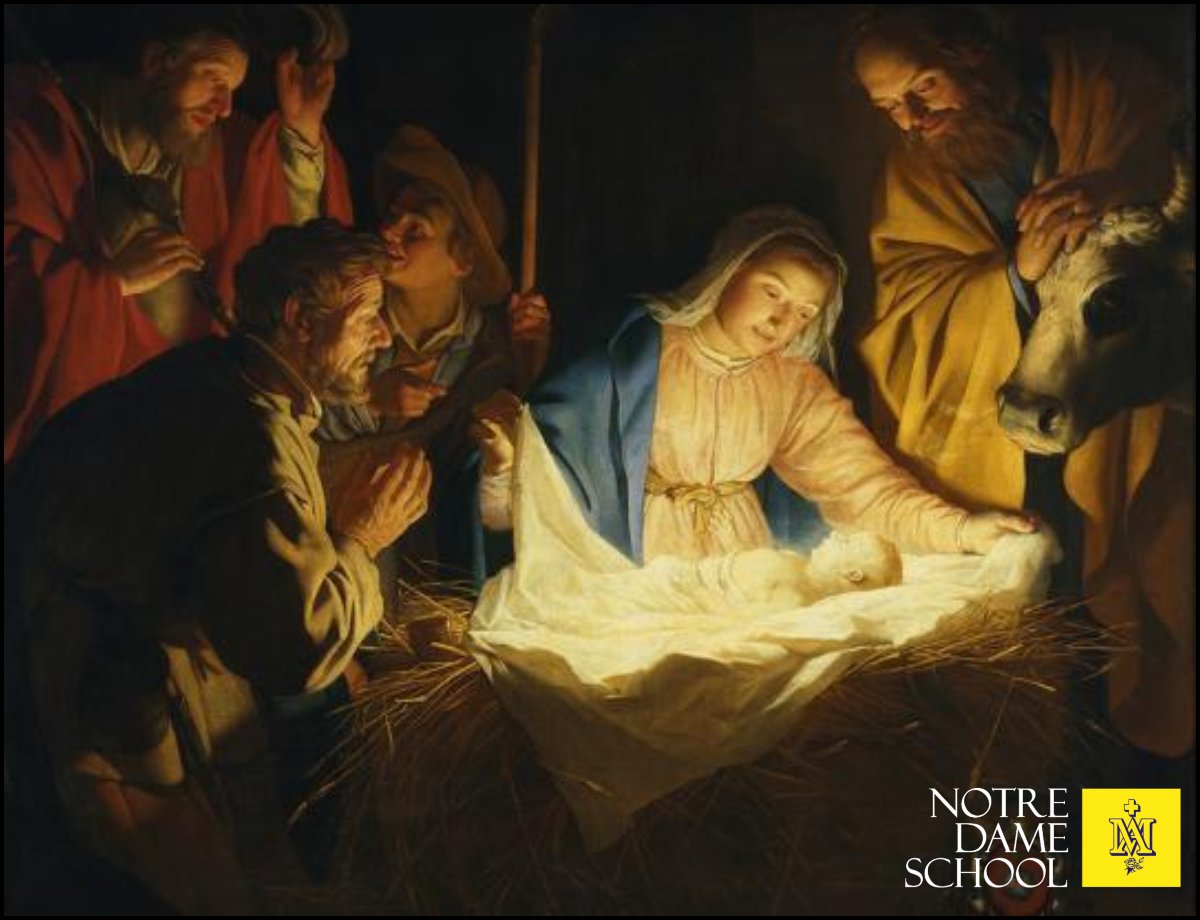
In this final Chaplain’s Corner before Christmas I have reproduced the words of my address at our wonderful Carol Service.
The events of the first Christmas quickly become very familiar to us. For many of us we would say that we know what happened that first Christmas. We have heard it retold for us in our Carol Service readings. We might have been listening and think, ‘I know what happens next.’
A good book or film, or a fine painting, or a memorable poem is often returned to time and again, because each time we read it, watch, study or recite it, a new level of meaning is revealed to us. The story or the plot or the image or the rhyme does not change, but the way the piece of work strikes us does. Familiarity can lead us to relate to it in a different and deeper way.
Whether we have been aware of the Christmas narrative, told to us mostly in the Gospel of Luke, for five years, or for fifteen, or for fifty or for more, the Christmas story has the ability to reveal to us new depths of understanding each time we engage with it.
Last week I was in the chapel with some of our youngest pupils. We were looking at our wonderful chapel crib scene and we talking about the role of Mary. Being familiar with the Christmas narrative even these young pupils knew that the Angel Gabriel appeared to Mary and told her that she was going to have a child. They knew that Mary, with Joseph had to travel to Bethlehem, and that when they got there there was no room in the inn, and so Mary gave birth to Jesus in a stable. These are facts of the Gospel narrative we too have very probably been familiar with from a young age.
In the chapel last week we sought to explore Mary’s feelings. Mary accepted her part in fulfilling God’s plan. She did it without complaint and without argument. Imagine the hardships with which she was faced, travelling for days on a donkey whilst very heavily pregnant, and then giving birth in a stable. Yet she accepted her part in God’s plan. She did not complain.
My new depth of understanding about the Christmas narrative came from one of those young pupils who told me and the rest of her class that she thought that not only would Mary not have complained, but in fact she would have been grateful. Despite the uncomfortable travelling, despite the undignified environment for giving birth, Mary was still grateful. Grateful for having Joseph by her side. Grateful for a roof over her head in the stable. Grateful for the warmth and the comfort of the straw on which she and her baby Jesus could lie. Mary did not simply endure; she was only ever grateful.
In everything there are blessings to be grateful for. So may this Christmas be a time when gratitude truly fills our hearts. For every present we receive, may we be truly grateful. For every meal that is shared with us, may we be truly grateful. For every moment of someone else’s company, anybody else’s company, that is given to us, may we be truly grateful.
And may we be truly grateful for the gift of the baby Jesus, the reason for Christmas, and the reason for our hope and our joy.
