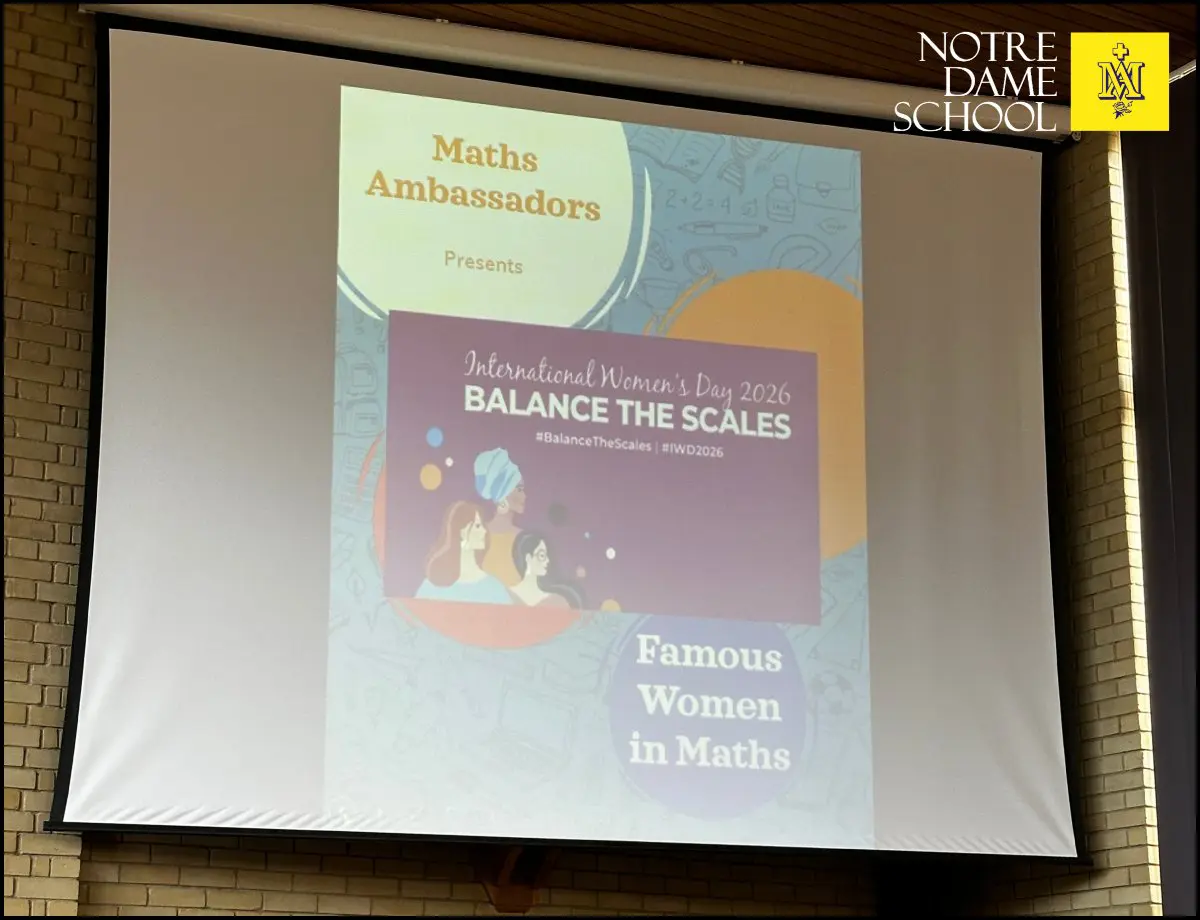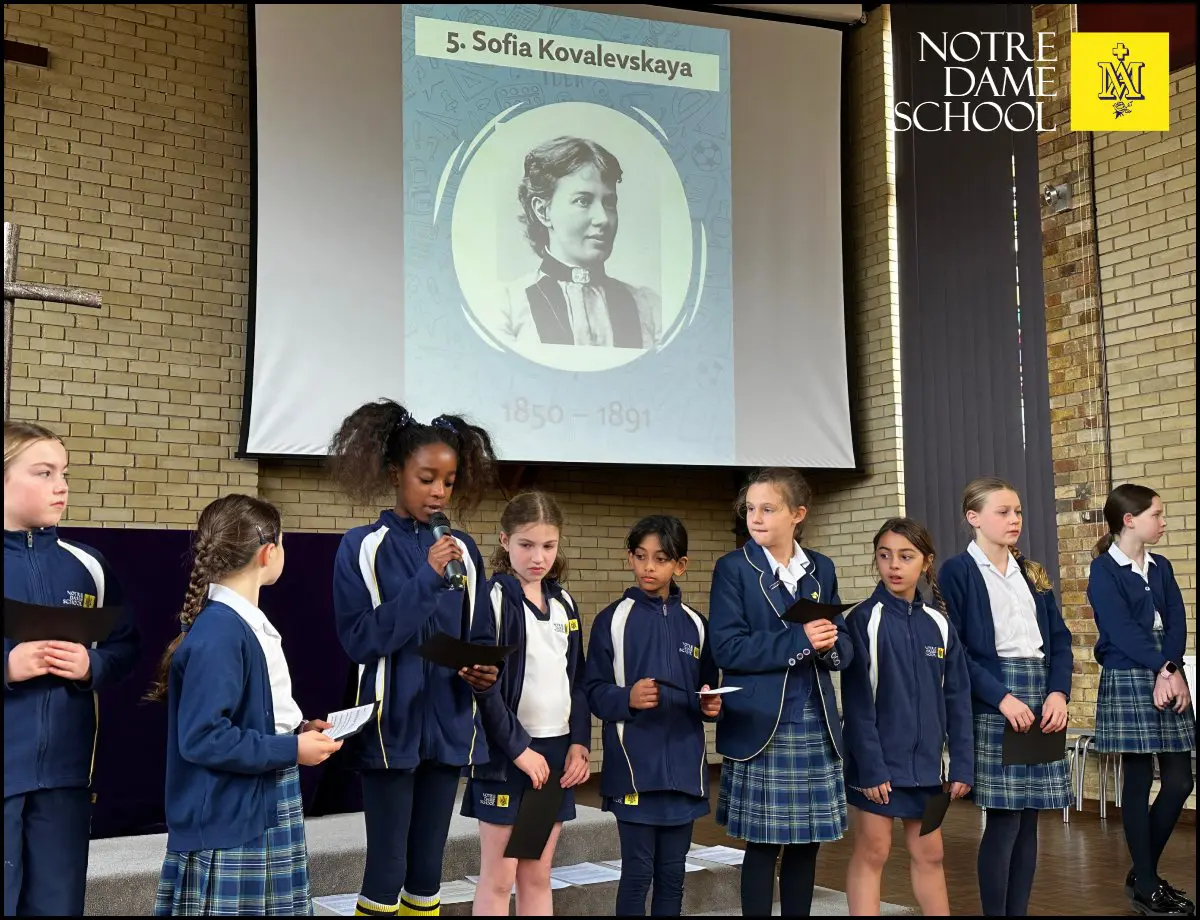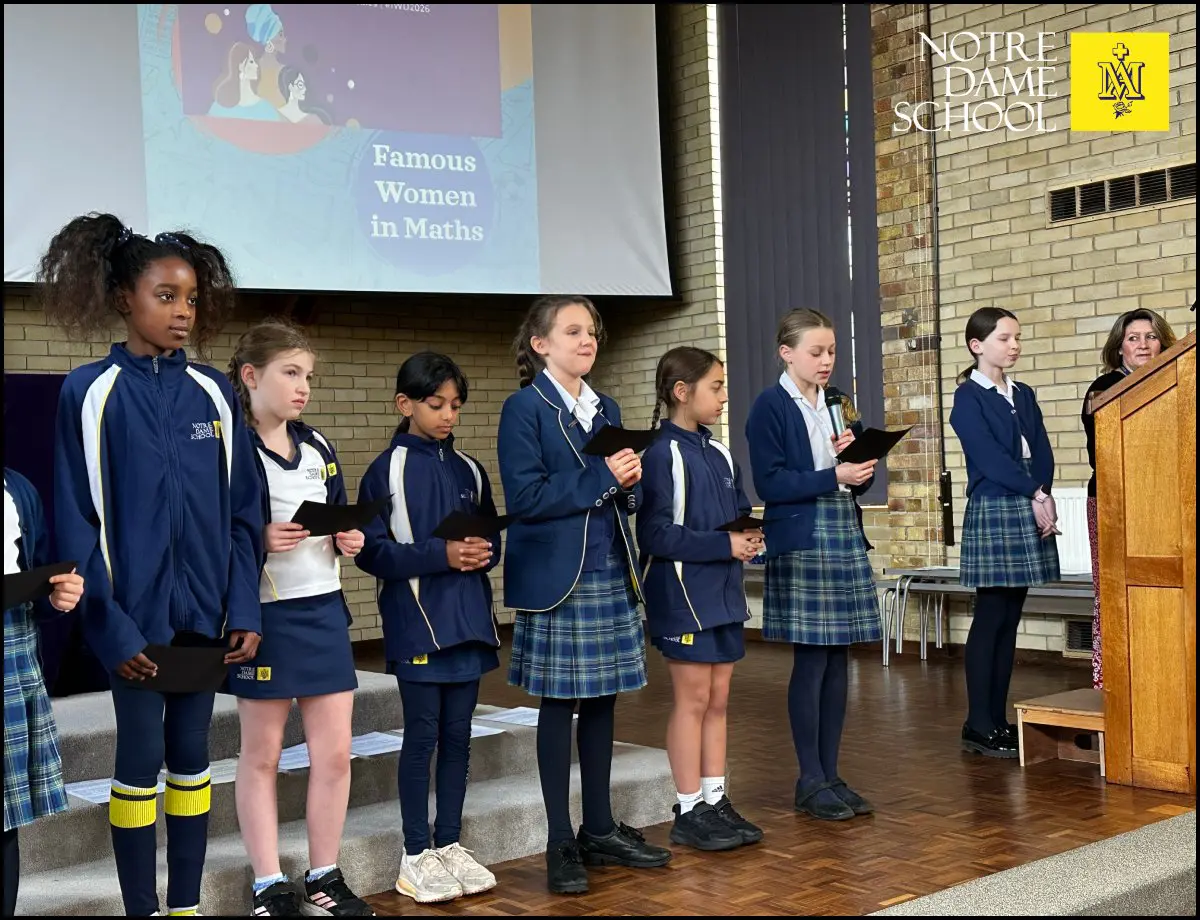

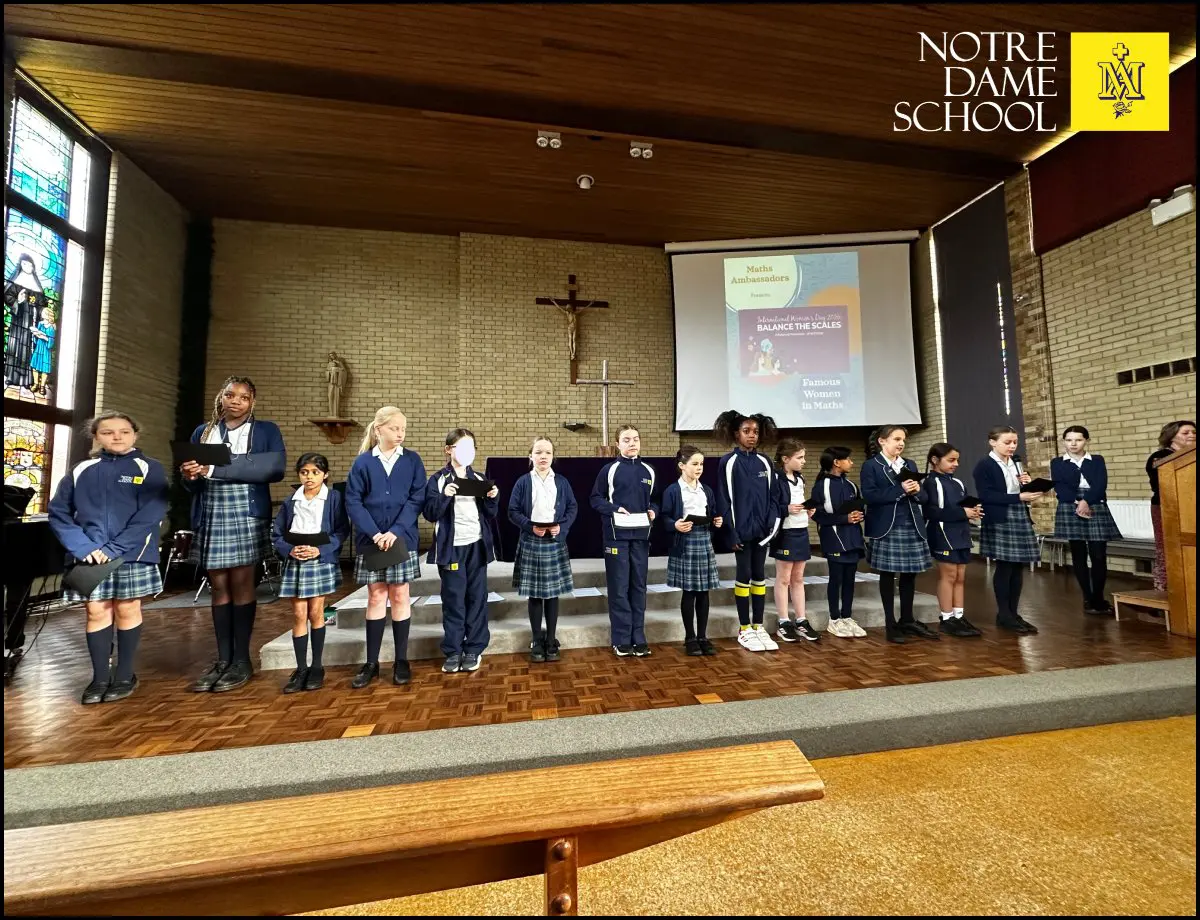
Our Maths Ambassadors ran the assembly today which was all about women who made a big difference in the world through the subject of MATHEMATICS.
Chances are you are probably aware of famous names like Newton and Einstein, but when it comes to famous female mathematicians, their achievements are less well known.
This may be because some people thought that maths was a not a subject for girls, but we know that could not be any further from the truth!
So in celebration of last weeks International Women’s Day, our Maths Captain and Ambassadors put together a fabulous list of some of the world’s greatest female mathematicians.
Maryam Mirzakhani, 1977-2017
Maryam was one of the greatest mathematicians of her generation, making amazing contributions to geometry.
She was a professor at Stanford University and held a Ph.D from Harvard University.
In 2014, she was the first woman, and first Iranian, to be awarded a Fields Medal, also known as the International Medal for Outstanding Discoveries in Mathematics, for her mathematical contributions.
Her work has had a huge impact in shaping maths and has opened up new research.
She shows us that, even in a subject which has lots of men, women can be role models and lead the way forward with their discoveries.
Katherine Johnson, 1918 – 2020
Katherine joined NASA in 1953 and her contributions were crucial to the success of the USA’s space programme.
In 2015, she was presented with the Presidential Medal of Freedom for her important work as a mathematician.
Did you know that Katherine Johnson was rejected by NASA the first time she applied, but she didn’t give up!
She was responsible for calculating the journey for two space flights, which means she helped the first spaceship and the first Americans reach the moon!
She always encouraged girls to pursue careers in S.T.E.M and often gave talks on the subject.
She says “Girls are capable of doing everything men are capable of doing.”
Mary Lucy Cartwright, 1900-1998
Mary Cartwright was a woman of many firsts!
She was not only the first woman to obtain a first in her university degree, but also one of the first mathematicians to study what is now known as ‘chaos theory’.
She was the first woman to receive the Sylvester Medal (awarded for the encouragement of mathematical research).
She was also the first woman to be President of the Mathematical Association and the first woman to be President of the London Mathematical Society.
She even has a mathematical theorem named after her!
Sofia Kovalevskaya, 1850 – 1891
Russian born Sofia made monumental contributions to maths. She was a pioneer and icon for females in mathematics and STEM subjects everywhere.
She was the first woman to obtain a doctorate in mathematics, and she went on to gain global recognition in the mathematical community.
She was awarded the Prix Bordin, a prize given to the best solution of a specific mathematical problem.
Despite doubts from the men in her field, and society as a whole, Sofia refused to give up studying maths and has paved the way for other female mathematicians to follow in her footsteps!
Sophie Germain, 1776 – 1831
Sophie was a French mathematician. Due to the unfair treatment of girls doing maths at the time, she could not have a job in the subject, but that did not stop her!
She worked on it independently throughout her life and through her hard work, Sophie was the first woman to win the grand prize from the Paris Academy of Sciences for her work in mathematics.
She proved to the people around her that women are incredible mathematicians.
Although she was not allowed to attend university, thanks to her determination and bravery, she became the very first woman to make important original contributions to mathematical research.
Marjorie Lee Browne, 1914-1979
Gifted mathematician Marjorie was the first black woman to gain a doctorate in maths.
She taught at North Carolina Central for over thirty years.
She was named chair of the Mathematics Department there in 1951, which allowed her to guide the way for some of the earliest computer use in her field.
She understood that the lack of involvement of black women in STEM subjects was a huge issue that needed to be addressed and believed that education was the solution.
She took advantage of her position to educate secondary school teachers in advanced maths and encouraging them to study and obtain advanced degrees which resulted in improving the level of maths education in North Carolina.
Her dedication to inspiring confidence in female mathematicians and providing quality education to others for the greater good has helped her to become a role model for women in STEM everywhere.
She said, “If I had to live my life again, I wouldn’t do anything else. I love mathematics.”
Rachel Riley
Television presenter Rachel studied Mathematics at Oxford University.
At age 22 she joined Countdown where she applies her maths skills on a regular basis, handling the letters and numbers rounds to find solutions to complicated problems.
She has gone on to present other shows including 8 Out of 10 Cats Does Countdown and The Gadget Show, and even starred as a contestant on Strictly Come Dancing!
She has visited many schools over the years to inspire children on the “joys of applied maths, quantum mechanics and time travel” and increase the numbers of females participating in STEM subjects.
She has shown us that pursuing your passion and studying maths at university can lead to us down different avenues, including a career in television!
Malala Yousafzai
Malala is a Pakistani activist for female educational rights, and the youngest person to win the Nobel Peace Prize, at just age 17!
She started participating in activism when she was only 11 years old and began writing blogs for the BBC detailing what life was like under Taliban rule and her beliefs on the important role education plays for girls across the world – and especially in Pakistan.
In her hometown, girls were banned from attending school.
After appearing in the New York Times documentary, she gained global recognition as a speaker on the education of girls and has brought about huge change in this area ever since.
She took A-Level Mathematics and is currently studying Philosophy, Politics and Economics at Oxford University. She has won many awards and has been named one of Time Magazine’s “100 Most Influential People in the World”!
Malala’s brave and determined actions illustrate that females do have the power to change the world.
She also shows us that education is a privilege, so, if we want to go on and study maths, we should!
Mary Somerville, 1780-1872
Mary taught herself maths at a time when education was not thought of as important for girls.
In 1827, Mary was asked to translate a book by the French mathematician, Pierre Laplace. Her work was an immediate success.
She continued to do lots of important research for the rest of her life and was given many honours for her work.
Her work was so important and famous that Somerville College at Oxford University is actually named after her!
Ada Lovelace, 1815-1852
When Ada was a teenager, she was taught by none other than Mary Somerville!
Ada was incredibly gifted at Maths and as an adult was asked to translate an Italian book about a machine that could do simple sums.
She did more than this and included her own notes and ideas to show a way a machine could do much more difficult calculations.
This machine is often called the first computer, but it was never actually built in their lifetime.
However, because Ada wrote a set of instructions for how the machine could calculate numbers, she is recognised for writing the first computer programme in history.
Emmy Noether, 1882-1935
Emmy had her education delayed because of rules against women studying Maths at university.
She was very, very clever though and did eventually get a PhD in algebra.
She went on to become a Maths professor and developed many mathematical rules.
Her mathematical rules led to other mathematicians – like Einstein – being able to advance maths even further.
We would not be as smart a society today if it weren’t for the work of Emmy!
Florence Nightingale, 1820-1910
Florence is famous for being a nurse who was full of compassion and the founder of modern nursing.
What is less well known is that Florence was a mathematician who used her work to cut death rates during war.
When Florence went to be a nurse in the Crimean war, she used statistics to show that lots of the soldiers were dying due to the conditions of the hospitals, rather than from fighting.
Florence’s use of maths helped to show government’s why people were dying. As a result, she helped reduce the amount of deaths in both the army and at home.
In particular, she developed lots of graphs and charts which made statistics easy to understand for politicians. Before this time, it was not common to represent statistics in this way.
Dorothy Johnson Vaughn, 1910-2008
Dorothy was an African American mathematician and computer programmer who worked for NASA.
She contributed greatly to the early stages of the American space programme.
She was considered a “human computer” as she quickly performed complicated sums and worked out answers for rocket launches.
When NASA started using electronic computers, Dorothy realised the future was in programming.
She learned FORTRAN, one of the earliest computer languages — and then taught it to other women.
Mayim Bialik
American actress Mayim studied neuroscience at UCLA, where she went on to obtain a Ph.D. She is best known for her role as Dr. Amy Fowler in the comedy The Big Bang Theory but has starred in countless other television shows and films.
Despite success in her early acting career, Mayim still decided to study neuroscience at university because she had a passion for the subject.
She believes strongly in the involvement of women in STEM subjects and has spoken at events on the topic encouraging girls to pursue these subjects.
She also loves to play the bass and trumpet!
All of the photos have been uploaded to Firefly and can be seen by clicking on the link below: